


08 Ott An interview with Fraser Kershaw, director and composer of “THE SUMMER OF LOVE”
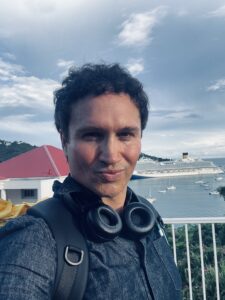
BIO
Fraser Kershaw is a filmmaker, producer, and educator whose work sits between live cinema, documentary, and experimental form. His newest film The Summer of Love, an 11 minute piece assembled over a decade under what some have called Kinetic Naturalism: shoot by the sun, let performance rewrite the scene, cut the way memory works. The film has been acknowledged by 69 festivals and official programs across six continents, with 15 awards.
He has been seen in earth friendly television commercials and collaborated with Francis Ford Coppola on the innovative live cinema concept called Distant Vision, produced and hosted the televised feature documentary Behind the Water, and has served as a Producer at WTJX, the PBS member station in the U.S. Virgin Islands. He has lectured in sport, art, and film at major universities. He lives and works between the U.S. and the Caribbean.
On the Mental Odyssey: The Summer of Love presents itself as a mental odyssey that transcends traditional storytelling. How did you approach the challenge of visualizing “unseen realms” where beginnings and endings meet, and what role did the American college town setting play in grounding this metaphysical journey?
People hear “mental odyssey” and ask If we had a vision board. Had a good hour of light occasionally, those few seconds of bliss seemed to open something some of us have never seen before. Yet we walked by that same curb thousands of times before. A tree stays put. We just had to notice it.
Most shorts are weekend auditions for a feature. This one took ten years and stayed eleven minutes. It was released at the perfect moment where humans are not willing to sit 2.5-hours for feature films. Mass produced shorts are a dime a dozen. If you linger on the same blocks long enough, they start talking back and that’s what we did. If the picture starts feeling like more than one lifetime, that is this town’s vibe from the crew, not a special effect.
The physical interaction between the protagonist and the tree at the center of the film feels deeply ritualistic. Can you elaborate on the significance of this gesture and how the contrast between the character’s mundane appearance and his solemn actions serves to bridge the gap between the material and the eternal?
in every town.


You mentioned the use of nine distinct cameras to “seamlessly stitch” this creation together. How did this multi-lens approach allow you to capture different layers of reality, and how much did your collaboration with Francis Ford Coppola influence this specific technical ambition?
Some said the $45,000 camera missed. The 1,000 dollar machine caught it. So, who’s to say which is better? Both were used, not on purpose. Stitchingthem together was a massive sin to most editors. But that’s how memories flutter.
Does the past appear in the same light, in the human mind, every time? Or do memories come into the mind on their own terms with their own lighting? We are all unique in a sense, so to frame a memory one way robs most of the crowd. We attempted to lay it out for all.
Live cinema with Francis will teach one nothing found in a textbook from a professor, because while reading, the scene has already happened. No do-over. I applied that, in nature. Daylight ran the set. No mapped beats. Light shifts, real milestones, people who were not pretending to be people were themselves for those moments.
If the truth is real, then why do actors have to act? The question was not how to cover it. It was counting fully on the light to bring what needed to be shown in unison.
In your Director’s Statement, you suggest that what is clear to one may remain hidden to another. To what extent do you view the viewer’s potential disorientation as a deliberate part of the artistic experience? Is the “confusion” a necessary step toward reaching a deeper, non-linear truth?
Some people see a love story. Some people see an environment with extra feelings. I wish I knew. I refused to feed with the silver
spoon. If you arrive wanting a clean “and then,” this will feel loose. Looking twice is more interesting than being briefed. What is obvious to you may be invisible to the person beside you. The visuals are the heart of the beholder.

What are you currently working on?
Kiki, the cat, who I took in from the street, sat on my calendar until I finished the cut. The people who demanded that they keep her, did not successfully keep her, because Kiki’s love was not for them. It was pretty apparent. I should have said no. That is the ultimate lesson. She is in Heaven now. The film went around the world, because of her. I grieve inside that she is gone.Streaming platforms ask for the option The Summer of Love but it was made to be blown up on the screen where it lived across the world. Figure some work wants air around it and this was where it was born to live. I can’t imagine it living between two advertisements on a cell phone. It would die. It was made for a community experience.
If you miss it, well, life goes on. There are more important things. There is always a new project. If it stays fun,I make it. If it starts feeling like a brand extension, I walk until the light does something I have not seen. Regardless, I think everybody should adopt an animal, bring it in the house, and take care of it like a human family member. The rewards are endless. In the beginning. That’s how it started.